Semi-Permanent day 1 – Future of the Future

Semi- Permanent is a design conference held in Auckland bringing leading speakers from around the world to give talks about the future of design over a three day event. I went with a number of VCD friends as we thought it would be an incredibly inspirational and valuable experience.

Day one was Future of the Future – focusing on talking about the future. There were talks from Ivy Ross (Hardware design Google), Bruce Mau (MCN), Charles Adler (Kickstarter Co-founder), Ana Arriola (AI + Research Microsoft), Carla Cammilla Hjort – Space 10

Some notes –

  • The Future of design is feeling
  • Intuition knows what your conscious brain doesn’t realise
  • The rules are
    meant to be broken
    temporary
  • 2025 – Human brain in pocket for $1000
    2050 – Access to all collective human minds
  • Design like you are lost in the forrest
  • Design a platform to solve future problems rather than just one solution – designing for 1000 years into the future rather than 20
  • Always live for the sake of self transformation

After these talks we attended a presentation by Elastic who do title sequences for many popular shows like westworld, game of thrones and true detective. They were in charge of making the opening video for semi-permanent.

After this day I was feeling quite inspired to be a designer. There was a great focus on ethics and considering the power that we have on the world as designers and we should be careful and considerate. Bruce encouraged that we are at a state where everything needs to be completely redesigned in order for the human race to be sustainable. It made me seriously consider what I am creating within my own work and how that could be used for good or bad.

Also watching Elastic’s talk on animation made me quite keen to explore some within my own project – animation is always something I have been quite interested in and wanted to explore much more than I have. Something to consider moving forward.

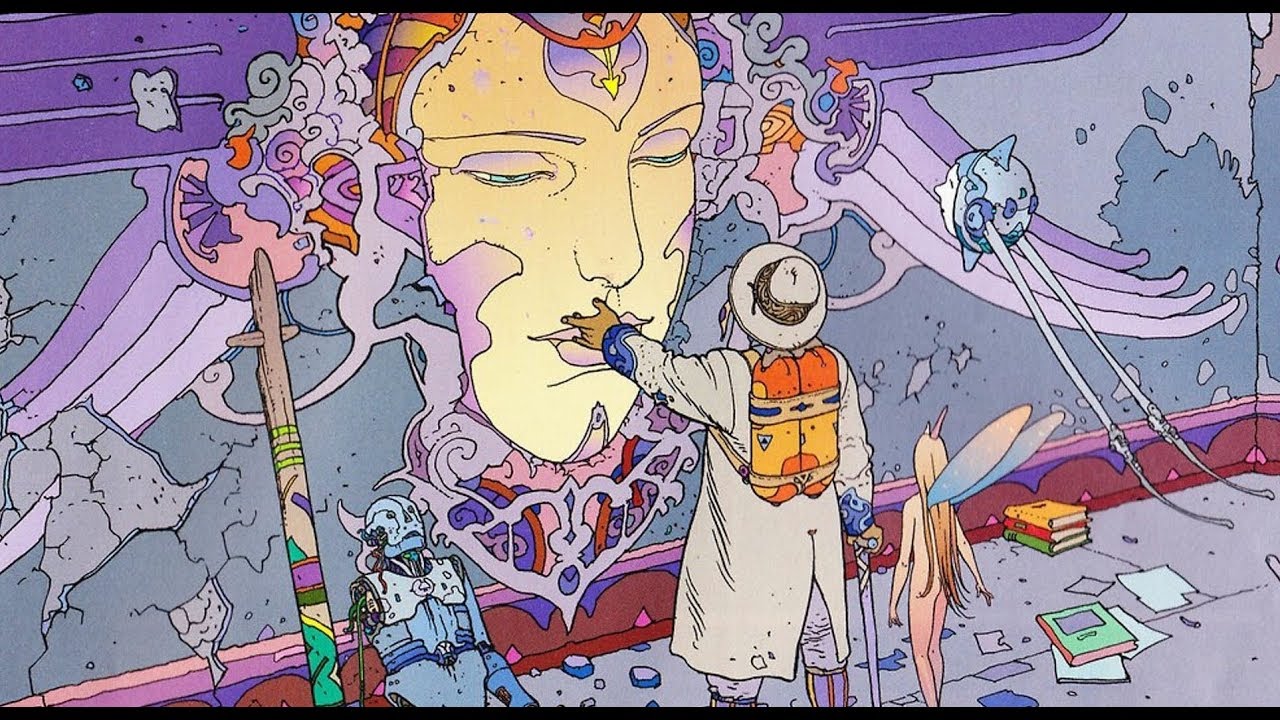
Moebius + Wayne Barlo

Moebius is a french artist and cartoonist working within fantasy/scifi

Wayne Barlo is a concept artist who has worked on big movies – He was in charge of the initial character designs for Avatar. His stuff is crazy and bizzare, definitely right up my alley and a great inspiration for character design.

Adjusting context

I had a meeting with Tanya about the direction of my project as I was feeling a bit confused and wanted some clear direction to think about while I was away for Semi-Permanent leading into supercrit.

Some notes on the feedback –

  • Project could be ‘future casting’ – looking into the positive/negative possibilities of collaboration with AI
  • Physical algorithms?
  • Mobias/Wayne Barlo – artists
  • Computers are like ‘magic’ to the average man who doesn’t completely understand the inner workings
  • Ethics?
  • Context – doesn’t need to be based on story – What planets are out there?
  • Really long canvas going around, showing different iterations (could connect together like exquisite corpse?) – Setup in the pit

The main point I got from Tanya was affirming that the project did not necessarily need to be based around an exisiting story, just as long as there was some context to ground it. For example I could imagine what sort of planets are out in the vast depths of space – what would AI come up with for this unexplored territory? How could that be applied within concept design/art.

Week 4 – Second showing

What I presented for the second showing in class. On the screen I showed some of the process behind my work with gauGAN, and below were some images that I had created using computer generated collaboration.

Feedback –

  • Beautiful example – The ‘how’ one can collaborate seems pertinent (in real life/online?)
  • Who’s it for + why also important (Fans of the genre? newbies?)
  • Gorgeous work, evocative of environments without being bogged down in detail.
  • Would like to see/understand more of the process and how the AI works eg what control it has etc.
  • Context? Understand what it is for, who is it for.

The main points I took from the feedback is that I need to give my project a much more clear context to situate it, which is still something I am working on. The characters were created with Avatar in mind, I was imaging that they could be characters for the next movie. This however was not too clear as it wasn’t developed far enough yet. Moving forward I will work on having a much more clear context.

Context – Avatar

One of the suggestions for my project was to base the designs and artworks around an existing story – how might AI interpret a story compared to a human brain?

I decided that Avatar would fit quite well to create content for based on the AI generation. Some of the landscape imagery that I have created already was looking like it could fit within the Avatar world. For this I was imagining that AI was being used to conceptualise content for the upcoming sequel of Avatar.

Looking at some different Avatar creature design

Generating a few different random shapes and attempting to create some Avatar inspired creatures from it.

I found this process to be reasonably successful but also a bit challenging. I did feel that trying to apply a particular outcome to a drawing took away some of the magic that came from embracing chance with the AI.

I was going to try some more grounded in reality stories but I just couldn’t think of a way that the program would enhance the process rather than just make it more difficult. If I was trying to create a human character the program could create a shape that doesn’t work at all for the output.

Landscape paintings

Generated imagery below

I then painted over in photoshop to clean it up a bit and give some extra definition to some areas.

Same process with this image.

This process was quite successful and interesting to do – the paintings are still quite rough and messy, they would need a lot more work to be finals but the program is definitely creating engaging and unique compositions.

I would like to try painting these with physical medium – I am extremely rusty with digital painting and much more comfortable with oils. A final image could be printed on canvas and painted over for a final potentially. This may also give a nice contrast between computer generated content and my input being physical.

GauGAN + AI testing

After seeing the great potential of Nvidia’s GauGAN for concept artists, I thought I would explore the possibility that the computer could use the program rather than myself.

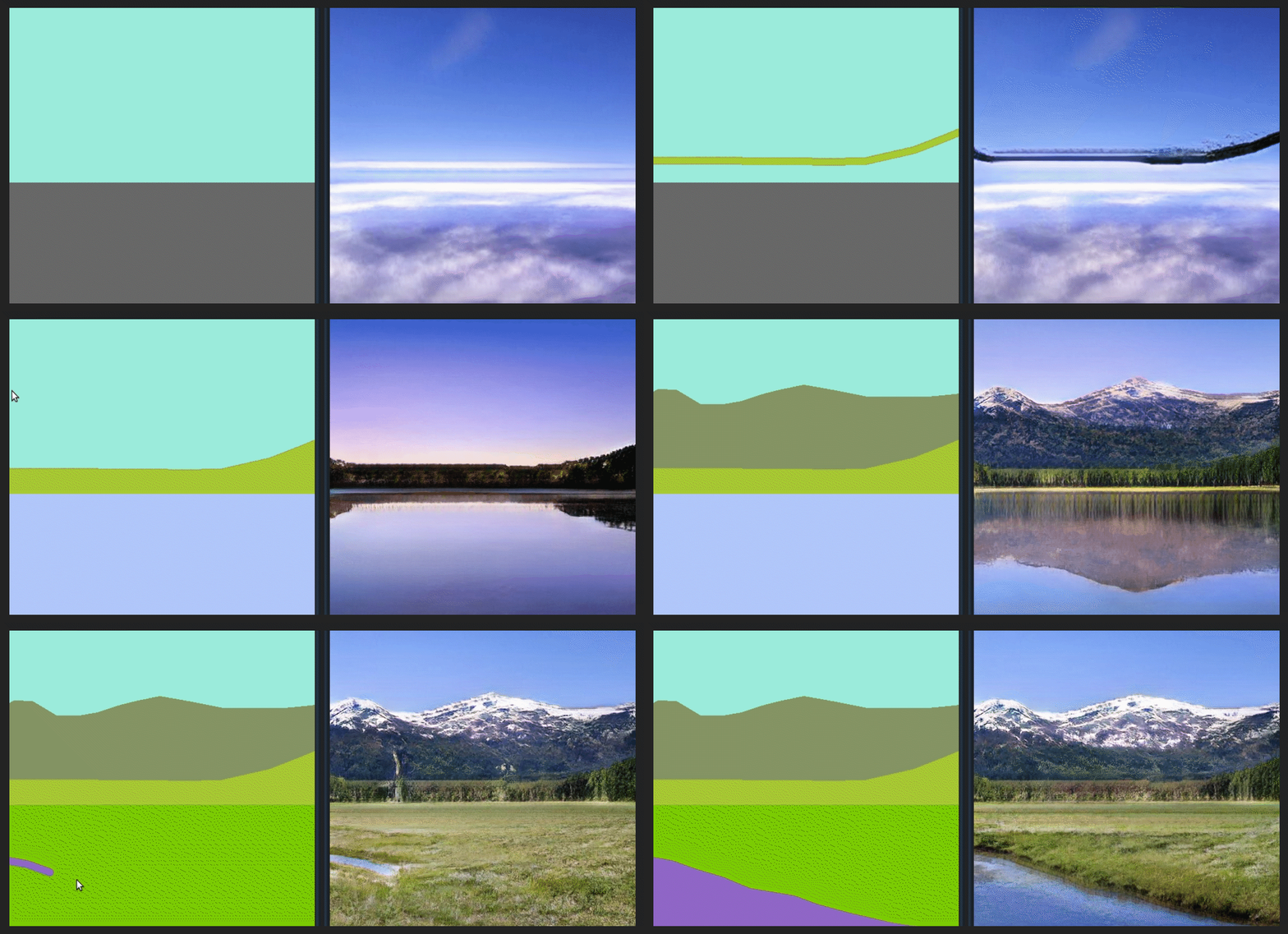
GauGAN allows the user to upload a ‘segmentation map’, which is just a jpg or png image of block colours, each colour representing a different landscape element.

Implementation into my existing generation program

Here I have set the background colour to sky and allowed the program to draw land. On the right is the generated output – interesting, but would like to give the program more freedom

Too much freedom… bit of a mess.

Adjustments – Changed the program so it fills in big blocks rather than small lines which didn’t really make sense for a landscape image, also limited slightly the colours that can be used.

The program has created some really interesting results – These could definitely be made into full landscape paintings. I can definitely see this process being used for creating the environments for my images in the future.

AI / Concept Design – GauGAN

Earlier in the research stage of my project I came across GuaGAN – a program by Nvidia which makes use of Generative Adversarial Networks to create photorealistic landscapes through a simple paint interface.

When looking for AI/Illustration collaboration examples which were specific to concept art I came across this program again – I found that it was released to the public a month ago and has been picked up by leading concept artists to work as a base for their art.

Video by Nvidia on guaGAN art

The artwork below was created by Senior concept artist Colie Wertz to create the base of the background.

Jama Jurabaev – Concept artist for titles such as Starwars, Kong:Skull Island, Ready Player One, Jurassic World: Fallen Kingdom

Some serious potential within this program – I would be interested in exploring this for my project. Perhaps I could use it to generate any background imagery, or at least inform. Or what results would I get if I could input computer control into the program, so that it draws the input sketch?

Pablo Picasso – Breaking the Rules

“Learn the rules like a pro, so you can break them like an artist.”

Pablo Picasso.

Pablo Picasso is well know for ‘breaking the rules’ in the art world – Many of his pieces were contriversial at the time. I am quite interested in the concepts behind his work as I have been exploring working within set ‘rules’ and how working like this while allowing room for freedom can be beneficial for creativity.

https://paintingdemos.com/breaking-the-rules/

Picasso’s work broke fundamental aspects of art in his work – although not too suprising to look at now, it was highly contriversial at the time of creation. Picasso broke the rules of perspective and depth – the image on the right makes use of his dual perspective technique, where two different perspectives are portrayed in the same object.

Reading – Creativity: When East Meets West
By Sing Lau, Anna H. H. Hui, Grace Y. C. Ng
Chapter 11 – Blue apples and purple oranges: When children paint like picasso

“At that age I could draw like Raphael … It took me years to learn to draw like these children.”

Pablo Picasso

This reading in exploring the inherent spontanious creativity that children natually possess. It is observed that children are creative, in a unique way which is desired by artists.

“Many prominent artists, including Kandinsky, Paul Klee, Pablo Picasso,
and Joan Miro have been intensely interested in the art of children —
collecting it, exhibiting it (some times along their own work), and most
important of all, taking specific formal cues from it.”

Fineberg (1995)

There are similarities in the qualities and feel of children’s drawings to that off my exploration within the project – whether through scribble drawings or AI generated/interpreted drawings.

In this sense the crude coding program I have been using to generate imagery could be compared to an uneducated child’s mind – It has yet to be filled with influence, direction, rules etc…

While this means the drawings often lack direction and dont follow the ‘rules’, they are raw and creative – unique. It is clear that many famous artists believe there is great power in working like a child.

Just I have considered that AI might allow us to tap into the potential of the subconscious imagination potential seen by the surrealists – could it also allow access to the crude, primitive child-like creativity we all possess at heart, possibily hidden under layers of influence and rules?

Developing Code

I decided to use the coding technique I developed for the poster presentation and flesh it out a bit more to make it work a bit more like I want.

I decided that I wanted to attempt to play ‘exquisite corpse’ with the computer in a sense. For this to work I had to change a number of things in the code –

  • Changed the way the boundaries work – now when the code tries to draw off the screen it heads back in a different direction.
  • Updated the timer for how long it ‘draws’ so it is a bit more varied, now the program might draw an elaborate shape for a while or just draw a very quick shape.
  • I can now determine any number of points that the code will begin drawing for – if I have drawn a body for example, I can set the two points for where the next begins and have the ai decide from there.
  • The program draws a red dot at each origin point.

I also had a go at creating some varying opacity – not sure this was completely neccessary